
Amanda Zito
Amanda Zito
Tattoo Artist and Illustrator
Instagram introduced us to the work and adventures of artist, Amanda Zito. She’s a trained illustrator and tattoo artist.
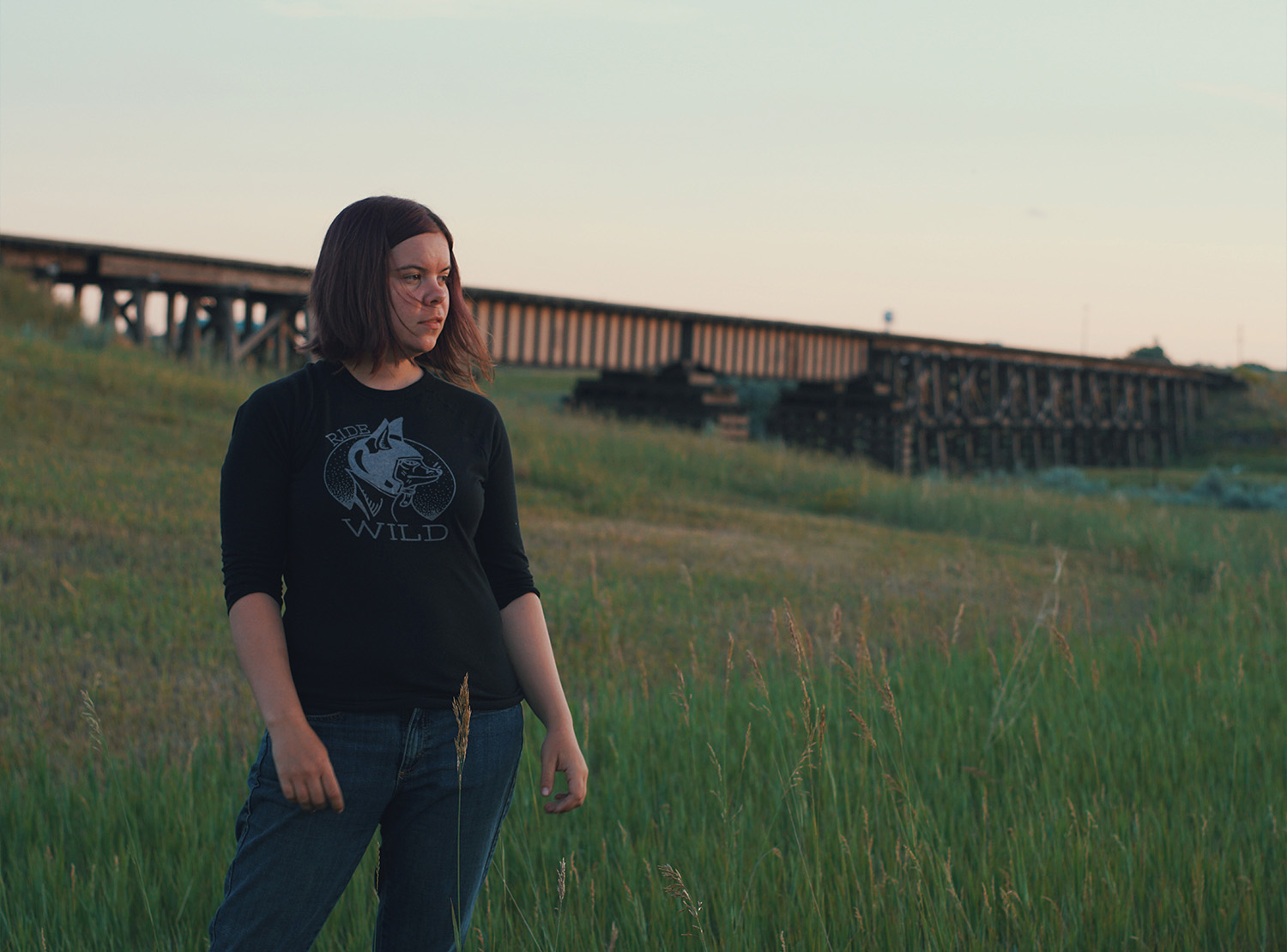
Amanda in her element
We were curious about how both those crafts meld in her work, and how she brings her experiences on a motorcycle to paper.
She’s an artist who’s often on the move (like a 3800+ mile motorcycle trip of Montana she dubbed “The Pilgrimage“), and that spirit carries through her work and the many ways she documents her two-wheeled adventures. In addition to her artistry and work in the motorcycle industry, Amanda hosts a motorcycle gathering each summer at her family’s property in Montana called Rocky MTN Roll.
Learn more about her craft, moto life, and get a taste of her adventurous soul. Interview below!
Find out more, in Amanda’s words:
You’re a trained tattoo artist and illustrator. How do each of those mediums inform each other in your work?
Learning to tattoo totally changed the way I think about Illustration, I definitely had to clean up my style a lot for it to communicate to skin.
I was ¾ of the way through college when I started my apprenticeship. I already had my basic foundations beaten into me like figure drawing, shape, contrast, value, color theory and all that junk. My main struggle at that time was color, I understood the theory -how to mix colors to make a different color- but I was really struggling with picking color palettes and rendering without it becoming a grey blob.
When I started tattooing, I was fascinated with the way that color sits in the skin. It is nothing like painting, there is no ‘blending’ it’s just fading from one color to another. It really made me think about how my work sits on the page in a different way.
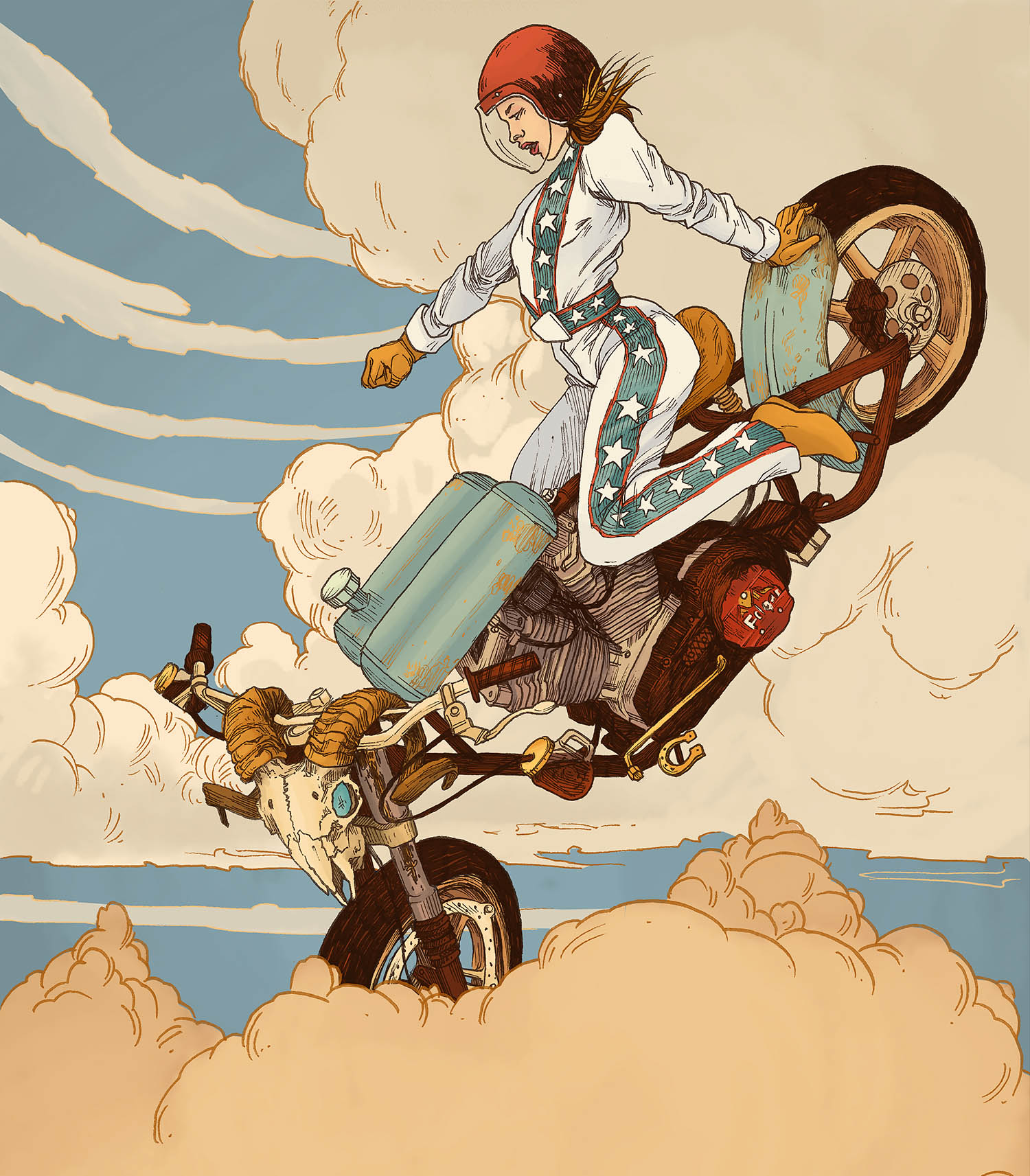
Poster Art – “The Worst Bike Show”
I also think tattooing forced me to consider design that worked without borders. Creating a good illustration has a formula of rules. Ya know, there’s the rule of thirds, create a good focal point, and make the eye go from the top left corner of the page to the bottom right.
However, with tattooing you have no set border. Suddenly you have to think about how your work is going to sit on the skin and how it’s going to work on whatever body part you’re going to be putting it on. ‘Wrap’ (how a tattoo warps around an arm or a round part of the body) is a thing I was not prepared for. A design that you make for a chest is going to be totally different from what you make for a hand, knee, or a forehead.
Looking back, I don’t think I would enjoy the challenge of tattooing if I hadn’t had the skills and experience that art school gave me. I’m grateful that I also had the design challenges that tattooing gave me to develop my work.
What are you passionate about, and how does your art serve those interests?
I’m passionate about Montana, Rural Life, and Motorcycling.
I experience homesickness like most people experience cravings, if you can imagine a craving plaguing you day and night. The good days are the days when I can bury myself in a piece that reminds me of home. Big skies. Mountains. Open spaces. And a lot of redneck. It helps for a time, but it’s really only a placebo.
I experience homesickness like most people experience cravings… The good days are the days when I can bury myself in a piece that reminds me of home. Big skies. Mountains. Open spaces.
I started riding Motorcycles in 2011. I had horses in Montana, but boarding horses in Portland, OR is kind of a nightmare. I figured if I couldn’t ride my horses, I needed something to fill the void. Motorcycles seemed like the next best thing. I had no idea how important they would become to me. It gave me a brief respite from my homesickness. When I’m on the bike I don’t think about how much I want to go home. All I think about is the road and the scenery immediately in front of me. I spent my first two years or so riding by myself, I saw it as a great way to get to Montana and back at half the cost of my fuel-guzzling car. The only people I ran into on the road were dudes. I had no idea there was a whole subculture of motorcycling until I found Motolady’s website.
Then I really became inspired to be a part of the moto community, and start creating work inspired by it. It is so incredible to me, the people I’ve met and have had the opportunity to work with in the motorcycling industry because I did a couple ‘doodles’ of women riding motorcycles.
-

- Amanda in front of her bike, Lazarus, in pieces
-

- “Moto Camp Feels”
You ride and document trips often, including a 3,800+ mile Pilgrimage around Montana. What do you love about motorcycle riding compared to other modes of travel?
I used to go from Portland to Montana and back, almost religiously at least once every 2 months. At that point in time I had a very reliable 1992 Oldsmobile Cutlass Ciera. Great car don’t get me wrong. I found myself feeling incredibly lonely in the car by myself, and did my best to haul ass from point a to point b.
Then I bought my first bike, a 1980 Suzuki GS850gl which I named Lazarus. My ability to sit in one spot on the bike for 500 miles was non-existent. My lack of endurance forced me to slow down and appreciate the landscape I was traveling through. That and the temperamental nature of a carbureted machine made me feel less alone. I felt more like the bike was my partner and we were making this trip together.
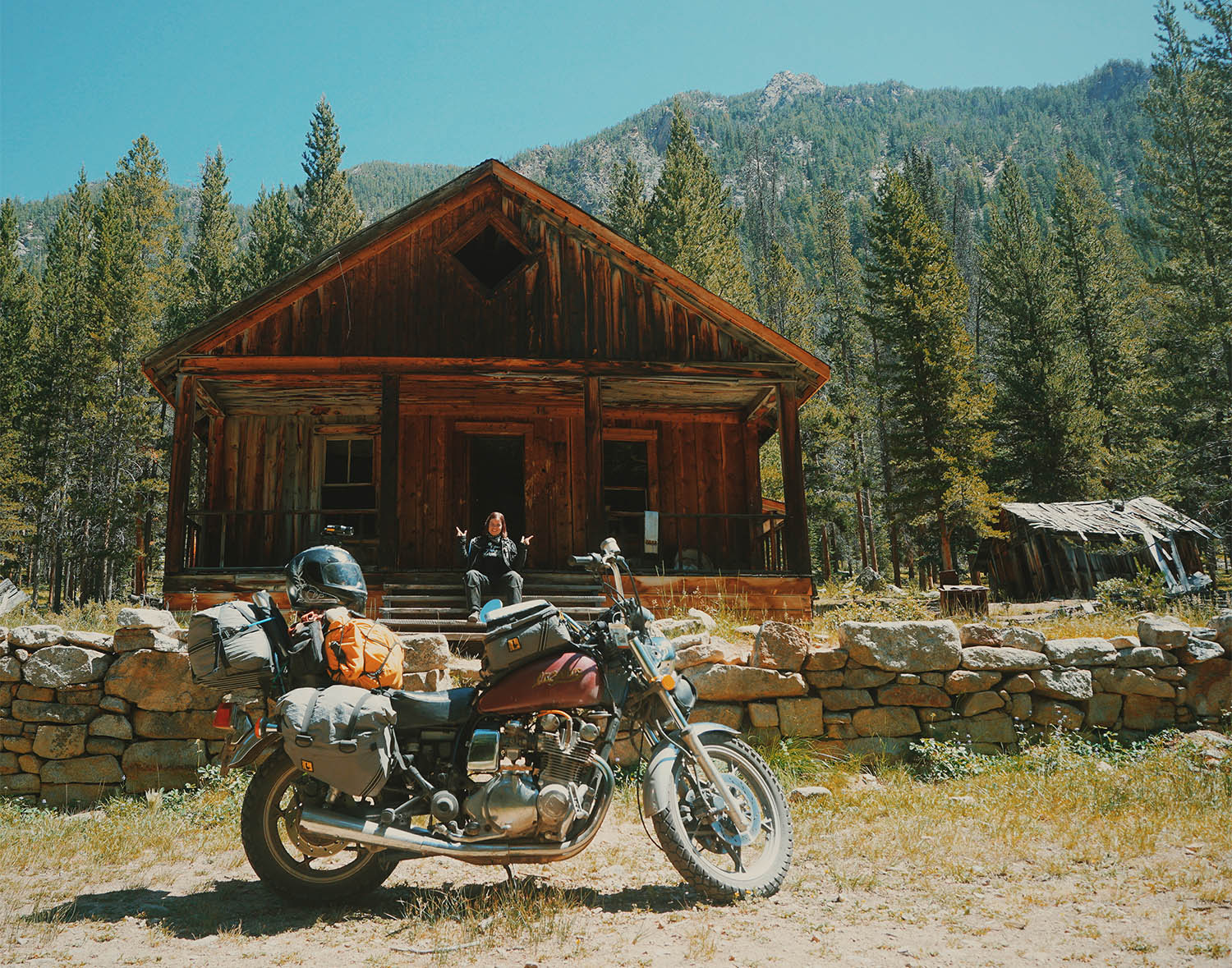
Coolidge, Montana
When I’m on the bike, I lose time and the rush kind of leaves me. I’m more prone to look at a road I’m passing, and turn around just so I can see where it goes. I’m so much happier traveling alone, because I don’t feel alone when the bike is with me. There’s of course the practical parts like the gas is so much cheaper, entrance fees to national parks are cheaper on the bike, and *knock on wood* when I break down on the bike people come out of the woodwork to help, even if I don’t need help. Last but not least, I love the community I have found because of riding.
How does riding inspire you creatively?
It’s the most stereotypical answer but it’s so true. The freedom that I experience while riding, is one of the most inspiring things I have ever experienced.
I haven’t mastered the art of drawing from memory quite yet, so I always have some kind of camera handy to take photographs of the particularly beautiful things I run across to draw from when I return home.
Not to be repetitive but going to motorcycle camp outs like Motos in Moab, Babes Ride Out, or (the campout I host on my family’s property in MT) Rocky MTN Roll, and meeting so many amazing people continues to inspire me. There are so many people who are so drastically different who ride motorcycles, but we’re all connected by one driving passion. If ever I start to lose faith in humanity, I know it’s time to hang out with my adventure buds again.
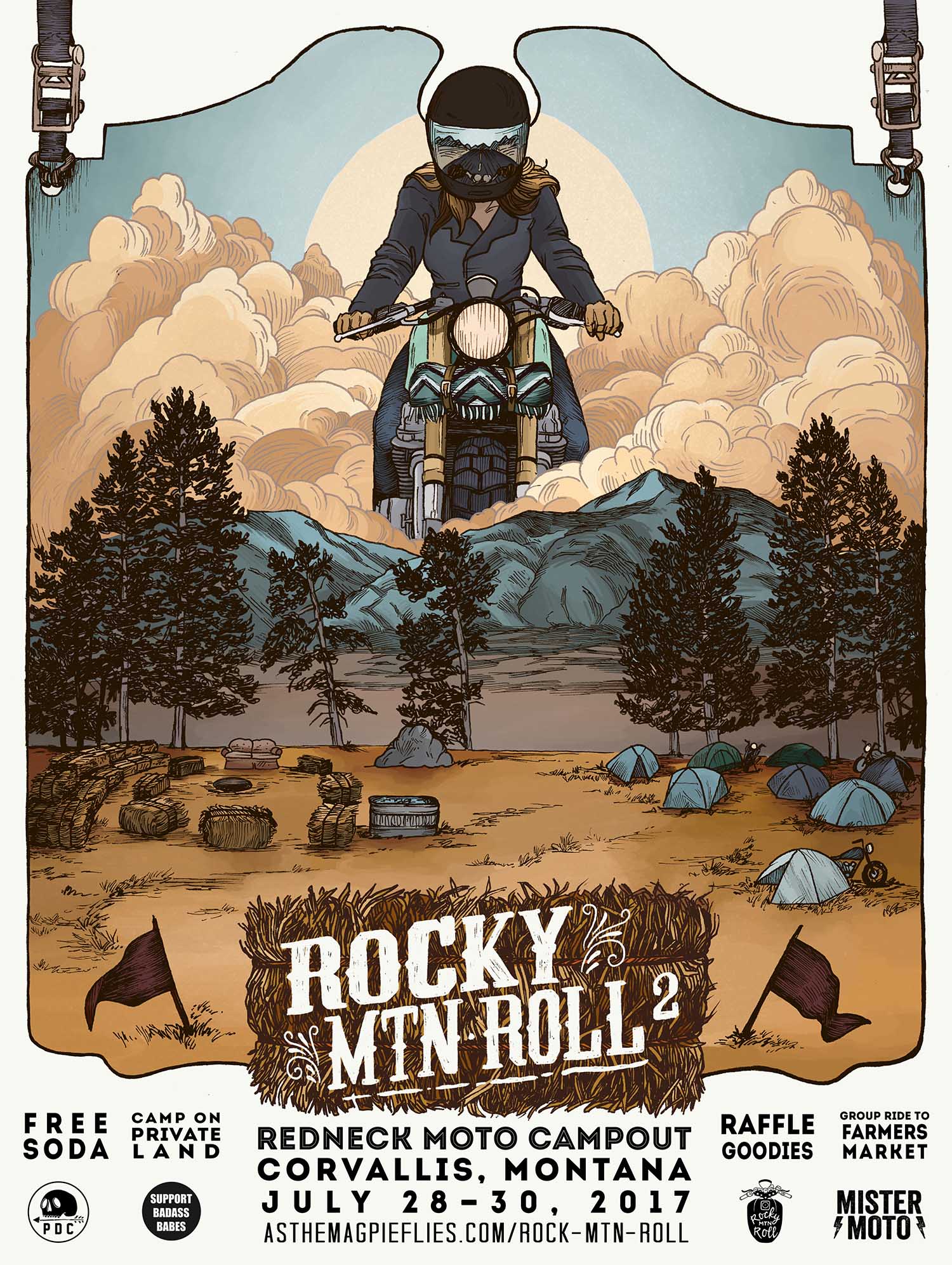
Poster for Rocky MTN Roll, the moto gathering Amanda hosts in Montana
Can you speak a bit about the Pilgrimage and the art that came from it? The rules of the trip include one on-location sketch per day.
So in May 2016, after three years at the tattoo shop I needed a change, so I quit my job and lived on the road for two and a half months. It was kind of a delayed celebration after graduating Art School, celebrating the end of my apprenticeship, and really reconnecting with myself and my roots. I decided that just riding around Montana wasn’t challenging enough so I made rules for myself like no Hotels (spoiler I broke that one a couple times), no GPS, no chain restaurants, and no freeways. Then I decided that I needed to make sure I was still creating content to share as a result of this experience.
I had no idea how challenging it would become to try and create artwork everyday on the road. I took my trusty pencil bag which I made in high school out of an old pair of jeans and a pink nightgown my best friend gave me. It was filled with some Straedtler pencils, a couple .01, .03,.05, and .08 Microns, a pink eraser and a pencil sharpener. My canvas, with the exception of a few postcards I drew on to mail to friends, was a 5”x8.25” green moleskin sketchbook which I purchased my first year of art school in 2010 and stashed away for a time when I was ‘good enough’ to draw in it.
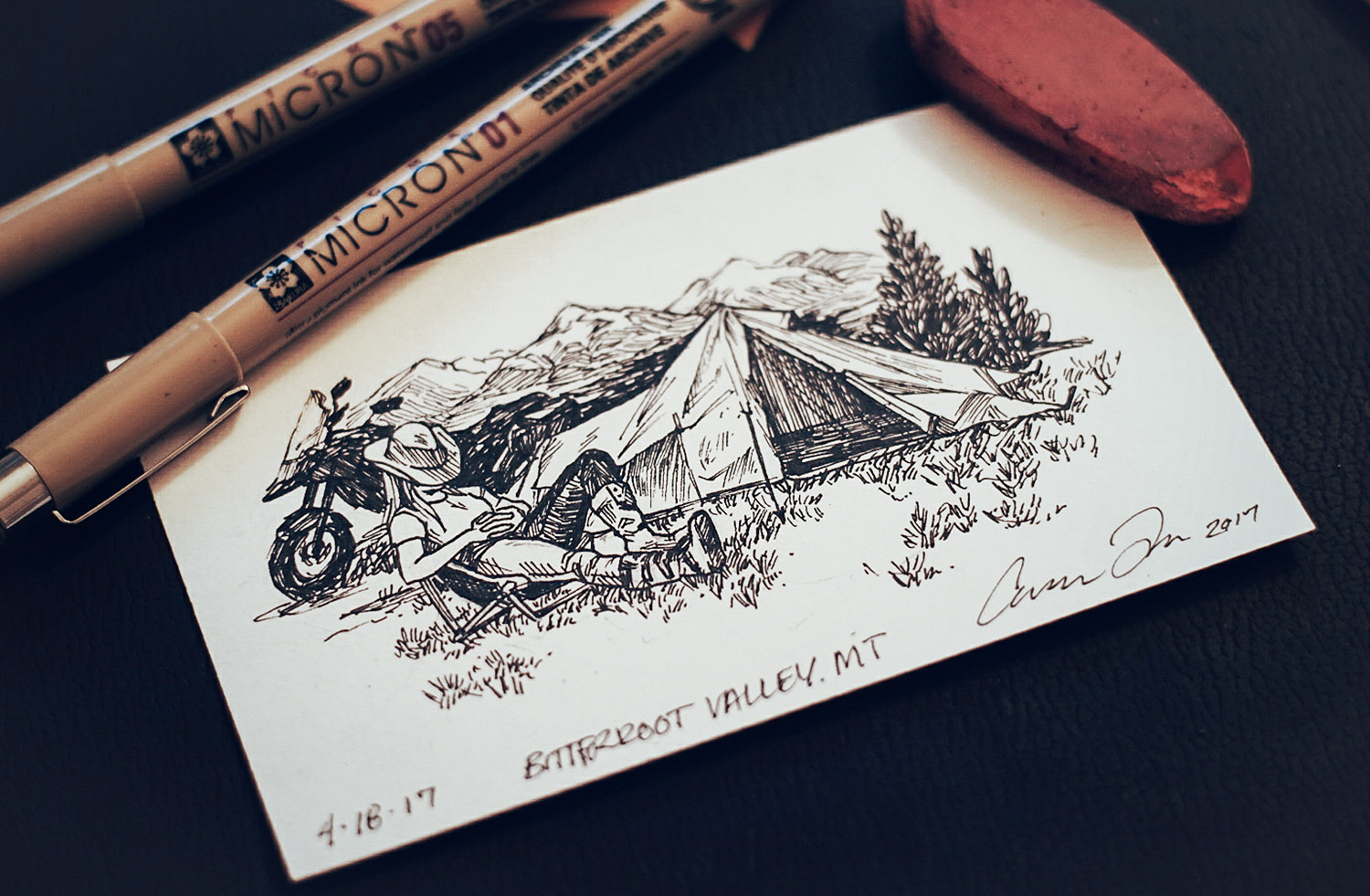
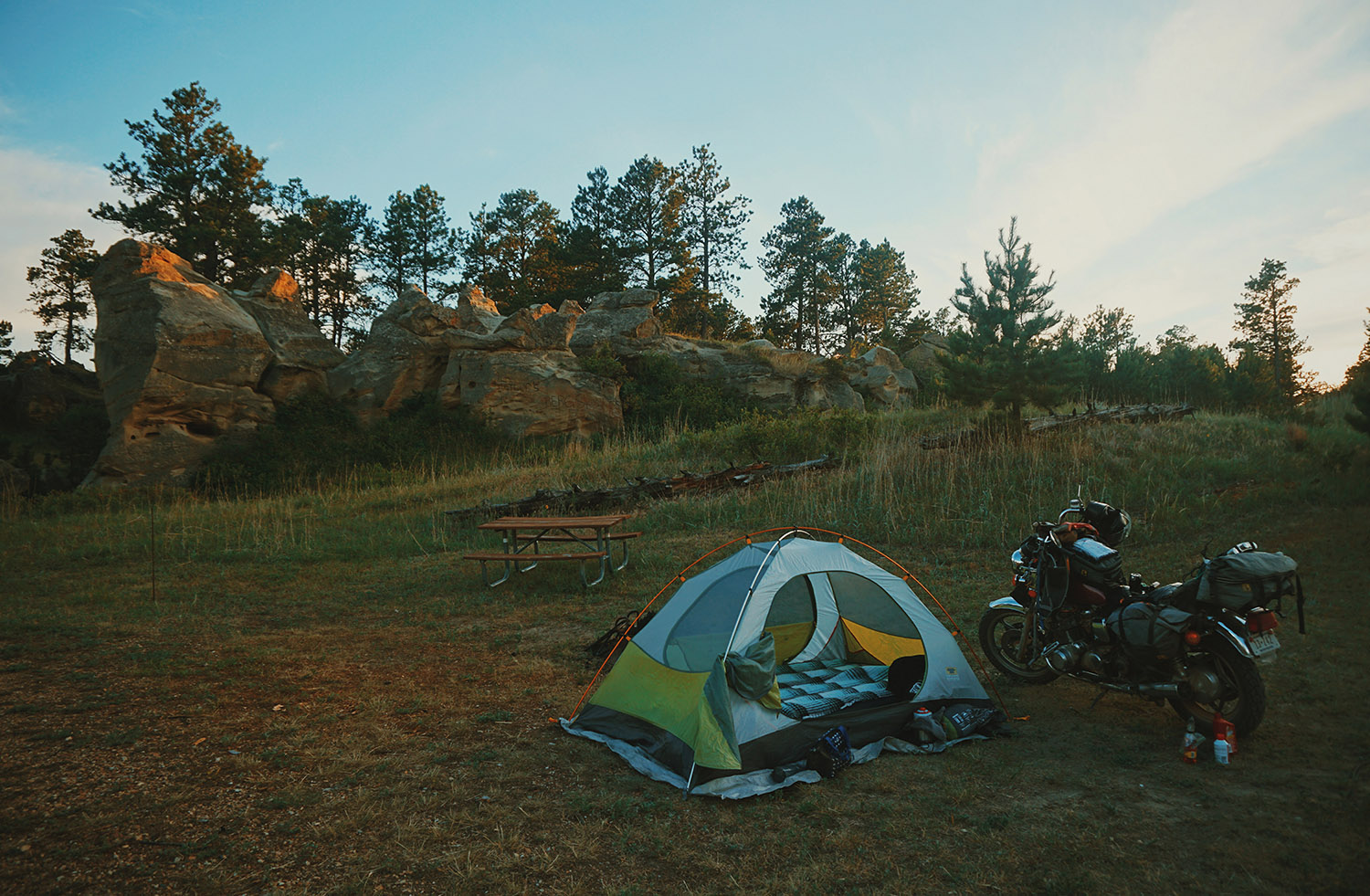
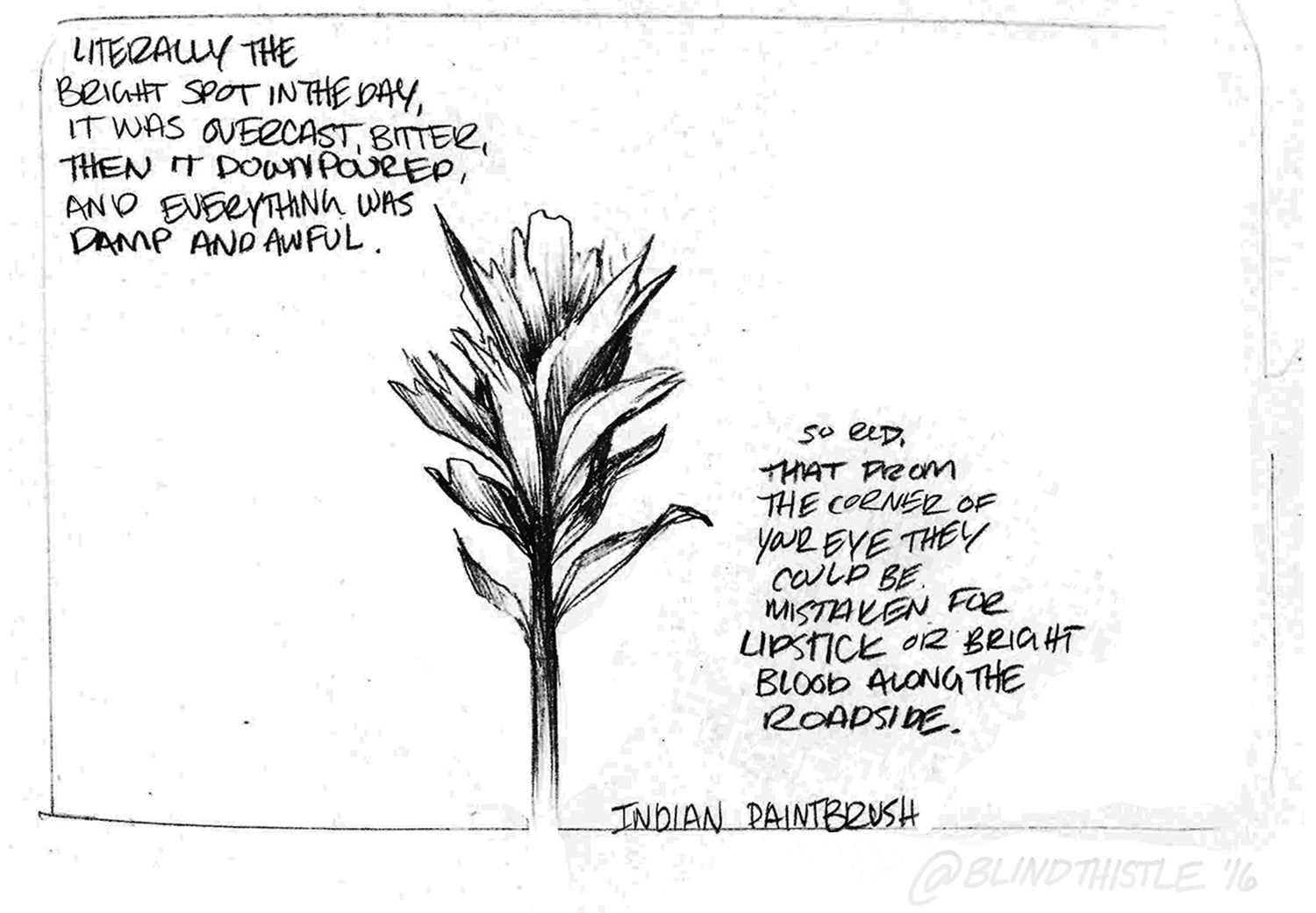
Amanda’s “example of a ‘bad’ sketch on the road”
I quickly learned that there wasn’t always time at the end of the day to draw, and it is incredibly uncomfortable to try and draw on a cheap air mattress in a tent with just a headlamp for light. I would ride into camp around 6-7pm , put up my tent, try to take advantage of golden hour for pictures, make food, then try to muster up the energy to draw. Most of my doodles that happened as a result aren’t shareable, they’re the beginning of sketch, that I obviously lost interest in halfway into ha!
There are some though, like the work I did after experiencing Makoshika State Park that I still love. Not necessarily because it was the best drawing ever, but because of what I felt while I was there, like this wave of awe was washing over me. I had never experienced a landscape that before. Makoshika State Park is on the edge of Glendive, MT in eastern half of the state, which I first discovered through Andy Austin’s photography, and it definitely left it’s mark on me afterward.
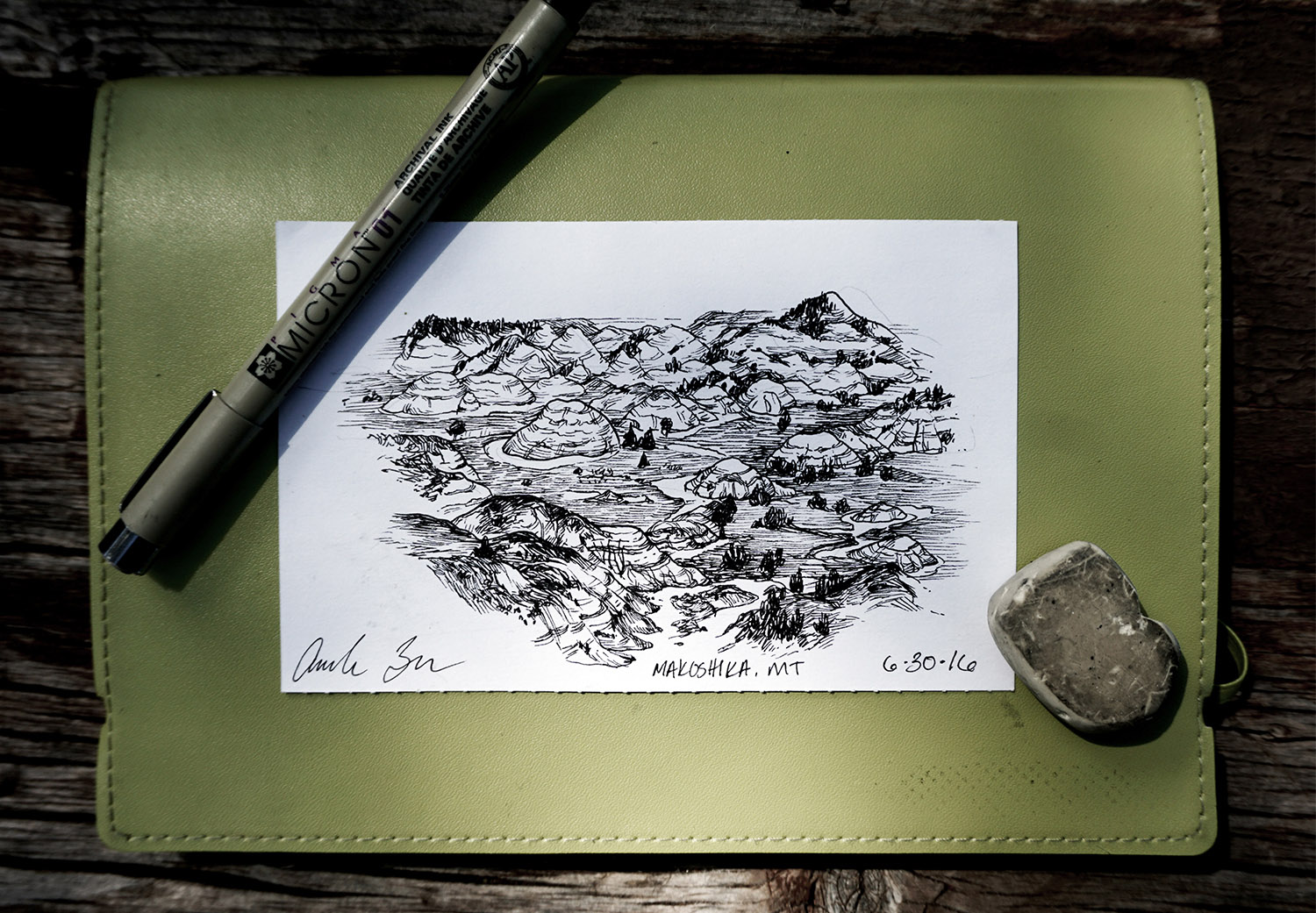
The green moleskin and the sketch of Makoshika State Park
Medicine Rocks State Park, the Big Horn Canyon take a close second place. Third I think would have to be this random spot outside of Rocker, MT when I came across a fireplace in the middle of the woods. Nothing around it. No wood, no debris or remnants of the house it was apart of. Just a fireplace and chimney in the middle of the forest. It struck me so much I did a watercolor of it after returning home. I think it stuck with me so much is because I had almost become accustomed to seeing the wreckage of old cabins and ghost towns in Montana, but this chimney was almost eerily separate. It was as if it was a snapshot from a different space and time.
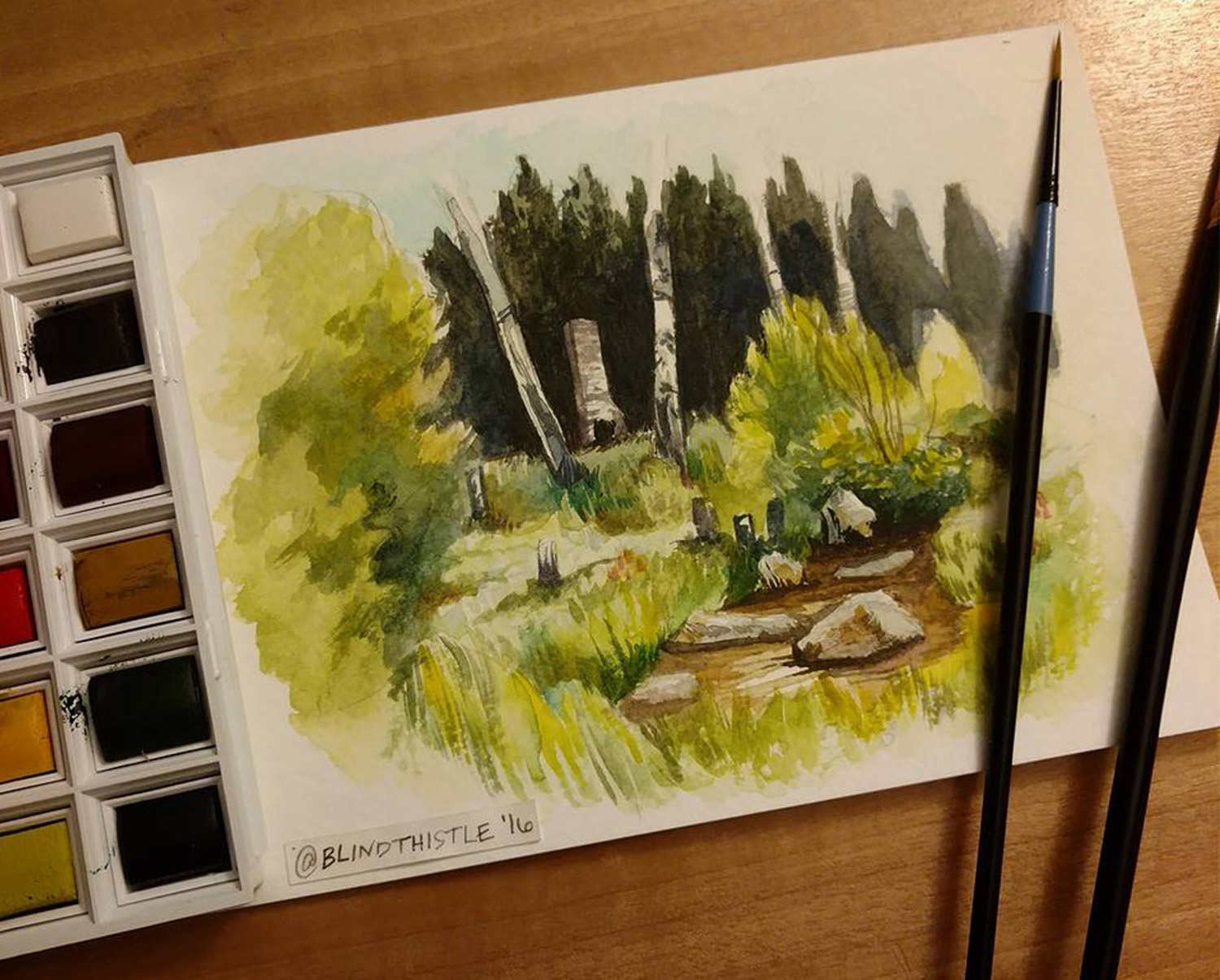
“The Fireplace in the Woods”
I love that your Instagram description says “No I will not draw your Logo or your “Great Tattoo Idea” – What kinds of projects do you take on, and why?
Since I returned from the Pilgrimage I’ve been working a full-time and then some job in the motorcycle industry. It doesn’t leave me a lot of free time for commissions, and I’m not as reliant on them for income as I used to be. So, I let myself be a bit more picky about what projects I take on. I started only taking commission work that had something to do with motorcycles, to try and keep my attention from straying while I was working. Friends that I had met through moto events started asking me to do the artwork for their event posters. It kind of snowballed and now I feel like I’ve become a specialist at event posters, and I kind of love it. It’s a new challenge, trying to figure out how to balance information and a striking image that makes you want to stop scrolling and pay attention. Some of the ones I’ve made are a better balance than others, but I’ve had a lot of fun making all of them.
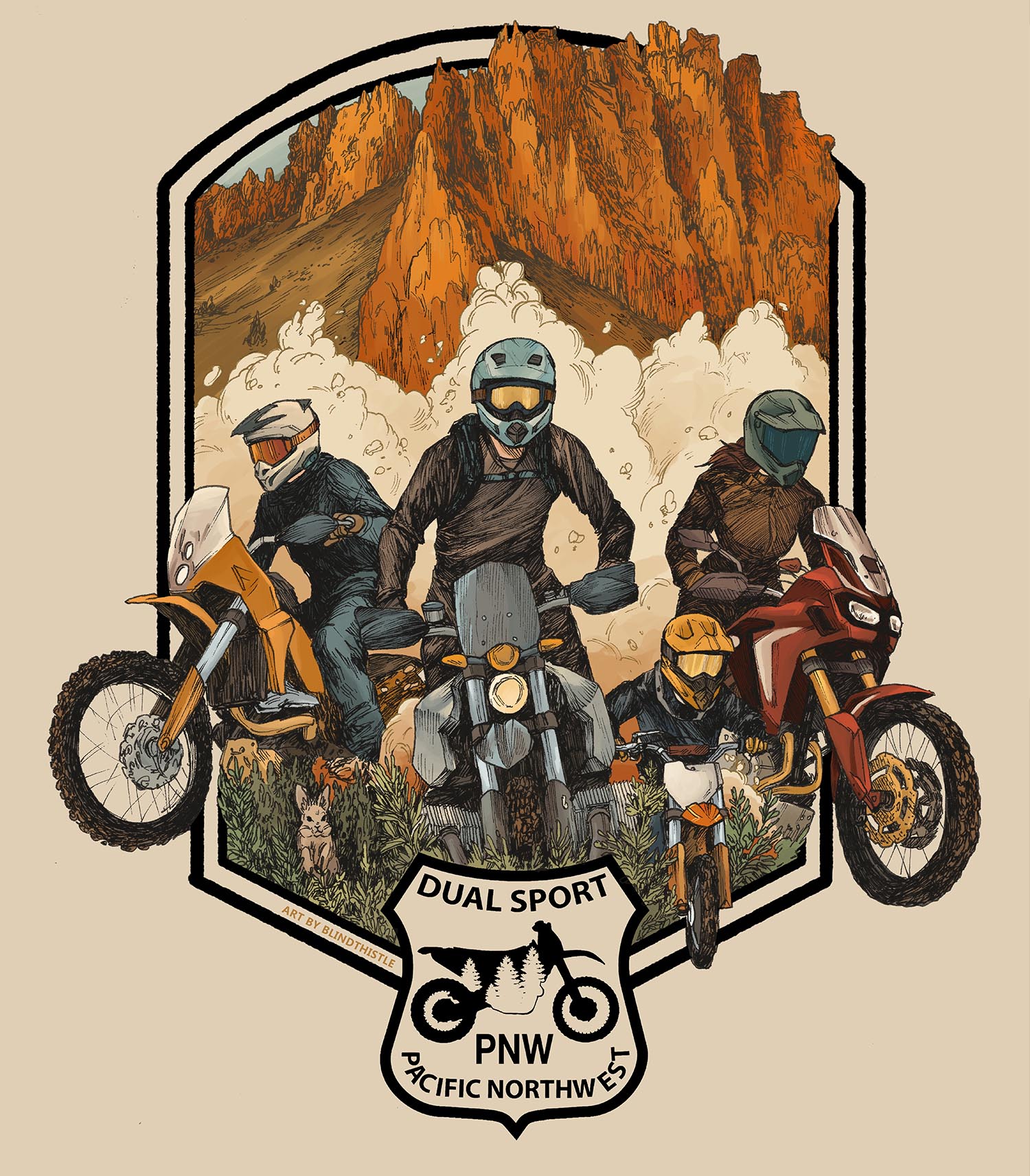
PNW Dual Sport Closer
The message in my Insta profile was really a result of my frustration about constantly having to say no to people. People who wanted me to draw their tattoos for them but not tattoo them myself, or the small companies that want me to make their logos for free because they ‘really don’t have that kind of budget right now.’ Ha ha! I’m not trying to be mean, honestly I’m really terrible at logos, Adobe Illustrator is like my arch enemy, so anything I make will essentially be useless. I also firmly believe that if you’re going let someone mark your body you should like the work that they do.
Speaking from experience a tattoo artist is way more interested in getting to tattoo their own work, not copy someone else’s. A tattoo artist that’s not interested in the work they’re doing leads to a shitty tattoo. It’s worth it to take the time to seek out an artist with a style you like, give them a rough prompt then let them have some kind of creative freedom. Those are the tattoos that come out the best and last the longest.
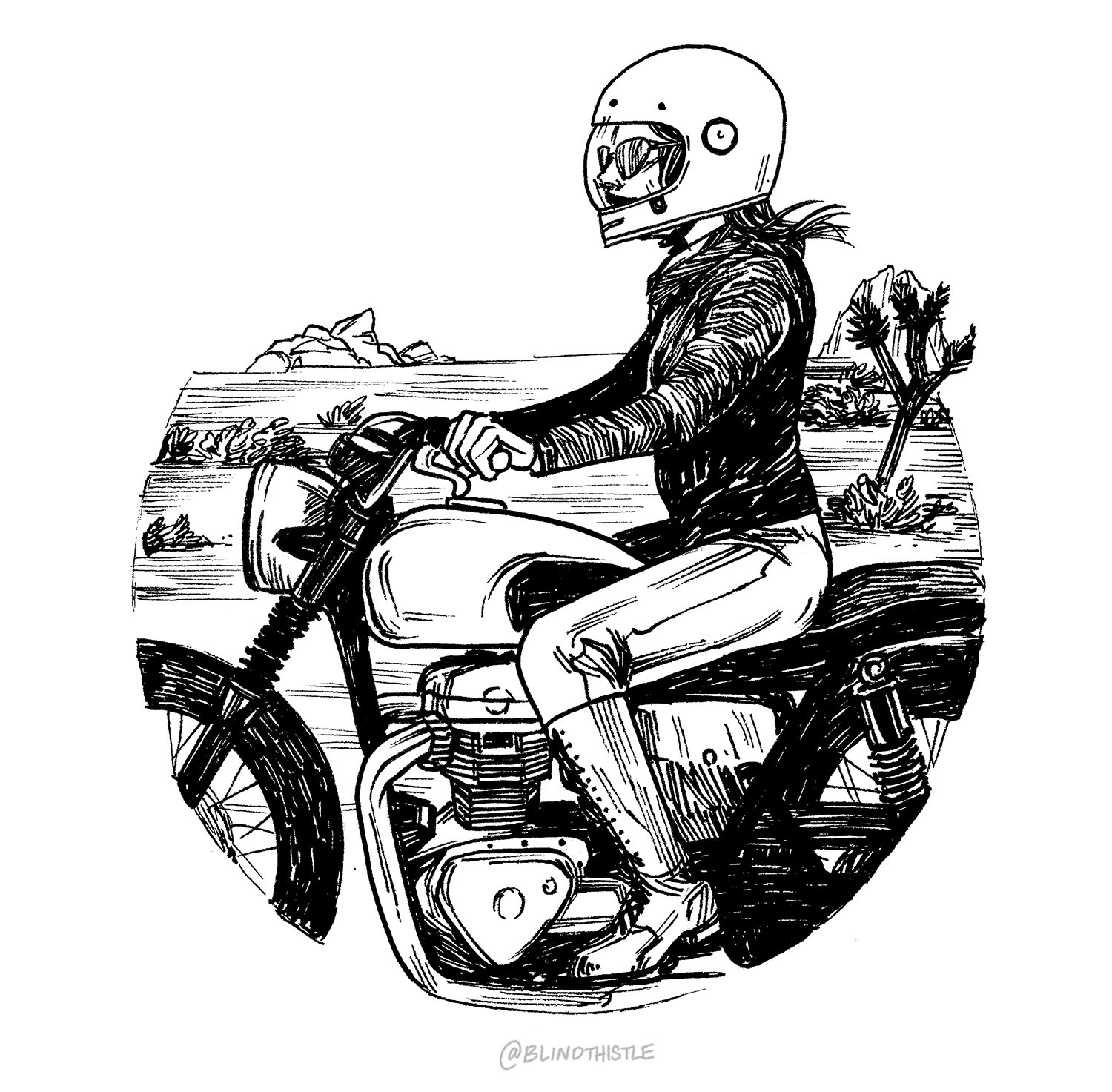
“Women Who Ride”
What ride are you most looking forward to next summer?
Well, I’m always excited for Rocky MTN Roll in July, I get to go home and have a big party at my house and invite a bunch of motorcyclists from all over the country to hang out. However, I am an impatient creature, so I am bringing Summer to me first thing in January.
A few coworkers and I are heading to Baja! I’ve never been outside of the country before, and this will be my first big trip on my new 2016 Triumph Tiger 800xc. We’re calling it Karl goes to Baja, in conjunction with a little project we call Karl’s Mystery Ride (which we started earlier this year and has been gaining traction with the Adventure Motorcycling community in the PNW). We’re hauling the bikes down to San Diego, then crossing the border on the bikes. I’ll be taking my camera with me, so you can bet that I’ll have a video up about it after we get back, and some new work to show for it. I am a big mess of excitement, nerves and anticipation!
Photos courtesy of Amanda Zito.
Amanda Zito is an Artist based in Portland, Oregon and Montana. Find more of her work on Instagram, see her portfolio at Blind Thistle Illustration, and follow her moto adventures at As the Magpie Flies and on Youtube.

Be the first to comment